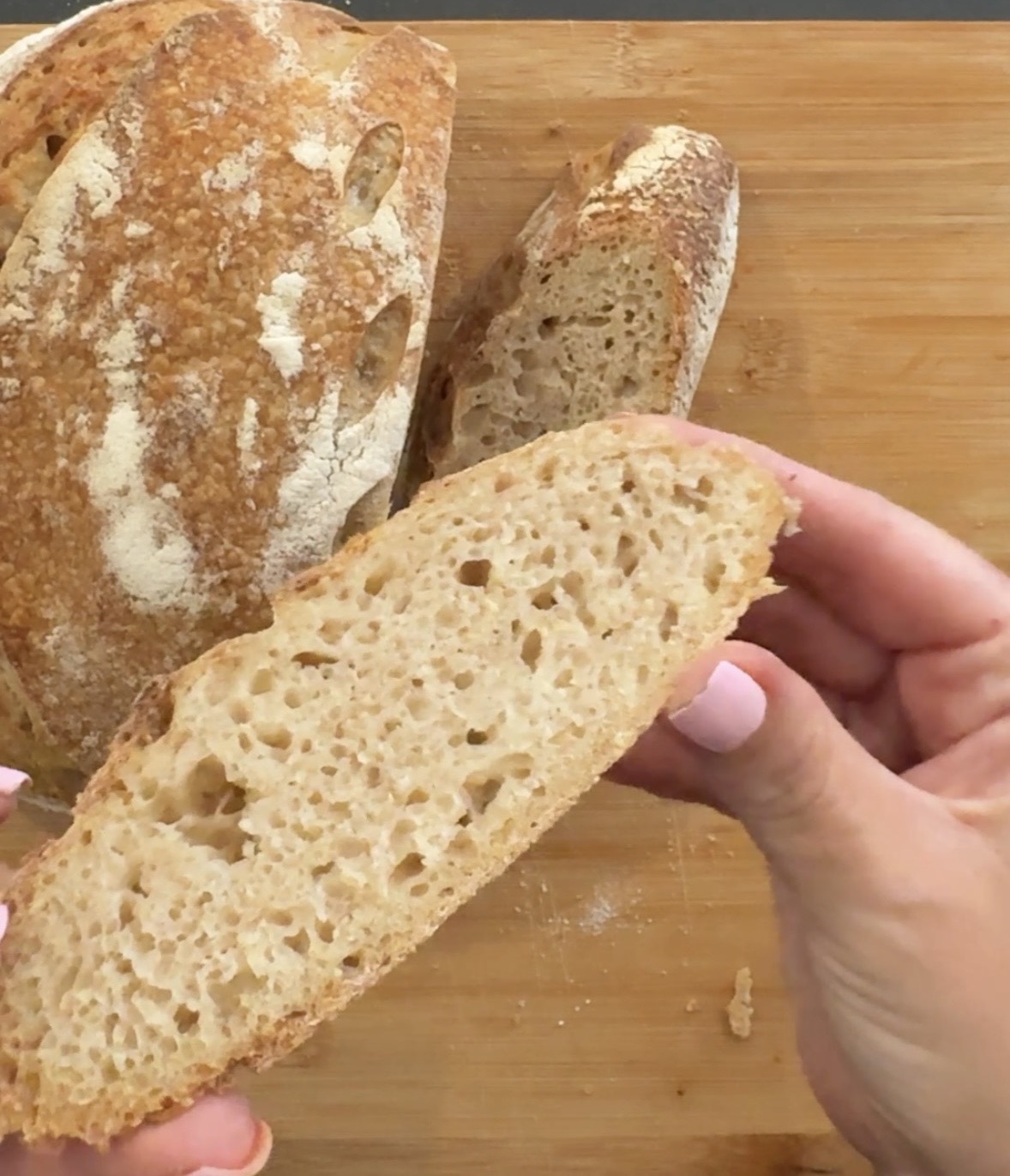
This Light Wholemeal (Wholewheat) Sourdough Bread is made with a balanced 50/50 mix of white and wholemeal flour, giving you the depth of flavour from whole grains without the density of a fully wholemeal loaf. The result is a soft, well-structured crumb with a golden crust and a lighter texture that works beautifully for everyday sandwiches, toast or serving alongside meals. If you enjoy wholewheat sourdough but want an easier loaf to master making your own sourdough my step by step recipe guide will help you achieve that.
Light Wholemeal Sourdough Bread (50/50 White & Wholewheat)
Light Wholemeal Sourdough Bread Recipe (Step by Step Guide)
Ashley’s Place
6 (approx.)
24 hours
45 minutes
Australian
Ashley’s Place
A 50/50 white and wholemeal sourdough bread with a soft crumb and balanced flavour. Lighter in texture while still full of wholegrain depth. Wholemeal (whole wheat) can be a harder sourdough to master as the flour absorbs water differently and can turn out dense, but doing it as a lighter 50/50 version still gives you a beautiful wholemeal loaf but much easier.
Ingredients
250g of High Protein Flour *see note 1
250g of High Protein Wholemeal (whole wheat) Flour *see note 1
100g of Active Starter *see note 2
325g Water
10g Salt (approx 1.5tsp-2tsp of salt depending what you use) *see note 3
Directions
To start this process you need to feed your starter to make sure it is active and at the right point to use. This depends on the temperature, your starter and how quickly it rises. If its hot this may be 4 hours prior if not if may need to be done overnight. You want it to be at it’s peak when we use it (*See note 2). We are feeding it the 1:1:1 Ratio and you want to do at least about 50g so you have 100g the next day and still a bit left to feed
Once your starter is ready to use, add your starter and 315g water into a bowl and mix well. Weigh your flour separately & mix that all together until your flour, water and starter are all combined. It will be more of a shaggy looking dough. Cover the bowl in a damp towel or cover and leave that for about 30 Minutes. I then add my remaining 10g of water and 10g salt into a jug or cup and give it a mix around so the next step is easier.
Add your remaining water and salt into the dough. Push down with your fingers to mix in the water and salt and fold it it till it’s mixed in. You don’t need to knead it or mix a lot just enough until it’s combined.
Now we leave it again for about 30 minutes and then do your stretch and folds every 20-30 minutes for about 2-3 hours. For the wholemeal loaf I always do 3 hours I find it needs it. Make sure you cover it after ever stretch and fold so it doesn’t dry out.
To do the stretch and folds, wet your hands to help it not stick to your hands as much. Simply lift one side up in the air and push lightly into the center of the dough, turn your bowl and do the next one, you do 4 folds and repeat this 2 x 4 folds, so 8 folds in total. Flip that over so the seem is on the bottom and leave again. Do this every 20-30 minutes or so, you don’t need to time the 30 minutes I just roughly do it every 20-30 mins
Once you have done your stretch and folds you want to leave it alone covered in the bowl for about 3-4 hours. A little tip here you can actually move it to a straight edge glass or clean container if you have one, when you put it in mark where the dough is with a texter or sticker. Because the dough goes straight up it is so much easier to see when it doubles rather than it a bowl. I always do this now
Leave for 4-8 hours. If you are in colder temps this may take up to 6-8 hours, in warmer temps it can be done in 4in my house in winter it takes up to 8-9 hours. It will depend on the dough and your temperature in the house. You want it to to be puffier, slightly domed and a bit jiggly and doubled in size. You may notice bubbles on top and it starts to slightly pull away from the sides. If you don’t leave it for long enough to proof it can be gummy even when fully cooked. This is where having a straight edge see through container really helps
If it is humid where you are try doing a 70-80% rise instead of double and if its super humid you may need to skip the next step and just shape it and pop in the bowl (see note 7*)
Once it has risen take it out of your bowl onto the bench. We want to do this stretch and fold again about 8 times again and then we want to start shaping it into a ball. Either by pulling the folds together into the middle and joining them or rolling your dough around on the bench to create a lovely ball shape and leave on the bench for about 30 minutes in this shape covered with a tea towel (I use the towel from my bowl). If your dough is feeling a bit sticky you can skip this step or do a shorter time. Just move to the next step
Re-shape one more time for the final shape (this shape will depend on what shape you are baking) but whatever shape you do, you want to really make this a tight ball and make sure the underneath where it all meets the seam is pressed together. We want it to be a tight ball so that it stays in that shape in the oven when we bake it.
Place it either in your bread basket covered with flour or place into a bowl with a tea towel dusted in lots of flour as you don’t want the dough to stick to either one. Pop covered into your fridge overnight. Make sure the basket or bowel is completely covered we don’t want it to dry out on top
About 1 hr before you are ready to bake pre-heat your oven to 240°C or with your pizza stone. 30 mins for a tray. 45 mins for a Dutch Oven (just make sure your Dutch oven can handle the higher heat it should say on the bottom), we need them hot so don’t skip this step.
If using a pizza stone or tray about 20-30 minutes before add a empty shallow tray for your water to go in on the bottom of the oven. Skip if using a Dutch Oven
Once that is pre-heated Start to boil your water so its ready to go
Get your dough out of the fridge and flip it out onto a piece of baking paper just a bit bigger than your loaf. This is so you can score the dough without being on the hot surface and it starts to spread. You want the seam side down and the smooth side facing up, with a sharp knife or scoring tool score the top of the bread in a line at least 1cm deep or add a design if you like, I like to do both so that I make sure it has a good slice in it then I add a design on the other side, you want to go about 1cm deep for this as it helps the bread rise evenly in the oven.
Now once it is scored pop your bread on top of your pizza stone, tray or in your Dutch oven and into the oven if you took it out, leave the baking paper underneath while it starts to bake.
Add boiling water to the empty tray on the bottom shelf of your oven to create a steam inside, this is so the crust forms but the inside cooks* See note 5
Bake away for a good 20-25mins and then turn the temp down to 210°C, cover with foil to stop it over browning if it already quite brown, if using the stone or tray, carefully take out the baking paper If using a pizza stone you can remove the baking paper, please do this with oven mitts or a tea towel it is hot! You want to bake this for another 25-30 mins until it is baked through and the base is golden as well. If your base is still blonde it likely needs more time. You can also knock on the bottom if it sounds hollow it’s usually done.
We want to bake it at the higher temp to help it rise and crust the outside but then we want to lower it and cover the top so that it cooks through and the bottom is cooked well too
Your cooking time will depend on the shape size etc of your loaf, but it should be lovely and golden brown. Leave to cool completely before slicing as things keep cooking as they rest just like in baking so you need to leave this for quite a few hours as it can be doughy if cut when it’s still hot.
blank
Feed your starter and leave to double and become active
Mix 310g water and starter together, add flour and mix together. Leave for 30 mins covered, the add rest of the water and salt and mix together. Leave for 30 minutes again covered then do stretch and folds for 2-3 hours every 20-30 minutes. Leave for 4-8 hours untouched to double.
Turn onto your bench, fold and stretch your dough 8 times at least and shape into a ball. Leave covered with a tea towel on the bench for 30 mins, re-shape for the final shape into a tight ball or the log depending on what you are making and add to flour covered basket or bowl
Pop into the fridge overnight covered
Pre-heat your oven to 240°C with pizza stone or dutch oven for 1 hour and add shallow tray to the oven 30 mins in.
Once done, boil your water. Flip your dough onto baking paper seam side down, slice a 1cm cut into the dough and add 2cm and then pop onto your stone or Dutch oven or so of boiled water into the shallow tray (place this on the bottom of oven) and bake for 20-25 mins then turn oven down to 210°C to bake covered in foil for another 25-30 mins until golden and baked through
Leave to cool before slicing