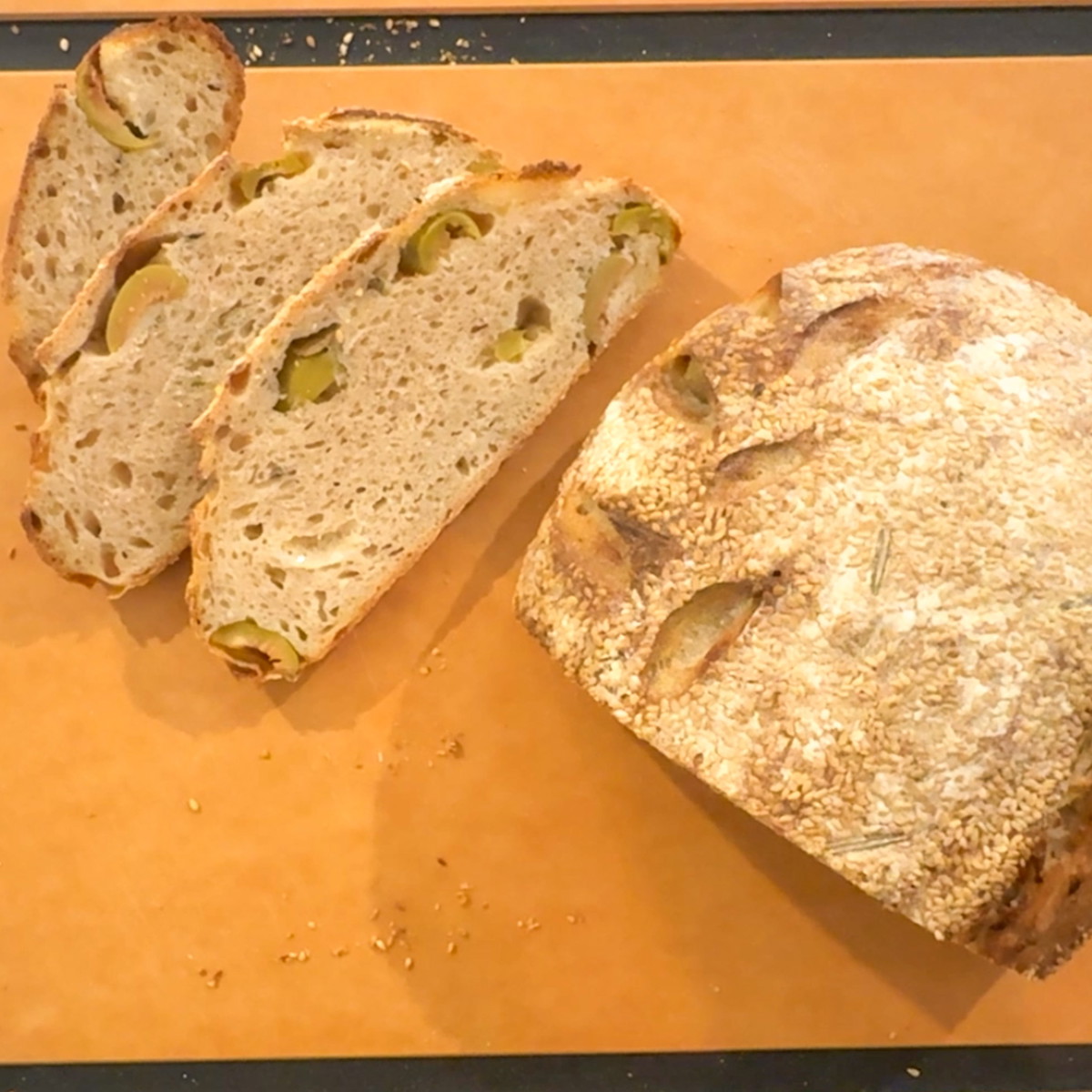
This Olive & Rosemary Sourdough Bread combines the tang of sourdough with the savoury flavour of olives and fragrant rosemary. With a soft crumb, crisp crust and pockets of olives throughout, it’s a beautiful loaf for serving alongside soups, salads, grazing boards or simply enjoyed with butter. The combination of rosemary and olives adds plenty of flavour while still letting the sourdough shine, making this a recipe you'll want to bake again and again.
Olive & Rosemary Sourdough Bread - A Flavour-Packed Homemade Loaf
Olive & Rosemary Sourdough Bread Recipe
Ashley's Place
6-8
24 hours
45 minutes
Australian
Sourdough
If you're looking for an olive sourdough bread recipe or a rosemary sourdough loaf, this recipe combines both flavours in one delicious homemade sourdough loaf. And if like me you love olives, then you should definitely make this one
Ingredients
500g of High Protein Flour *see note 1
100g of Starter *see note 2
325g Water
10g Salt (approx 1.5tsp-2tsp of salt depending what you use) *see note 3
150g Green Olives *See note 4
3-4 Sprigs Rosemary
Directions
To start this process you need to feed your starter to make sure it is active and at the right point to use. This depends on the temperature, your starter and how quickly it rises. If its hot this may be 4 hours prior if not if may need to be done overnight. You want it to be at it’s peak when we use it (*See note 2). We are feeding it the 1:1:1 Ratio and you want to do at least about 50g so you have 100g the next day and still a bit left to feed
Once your starter is ready to use, add your starter and 315g water into a bowl and mix well. Then add your flour and mix that all together until your flour is all combined. It will be more of a shaggy looking dough. Cover the bowl in a damp towel or cover and leave that for about 30 Minutes.
While it is resting add your remaining 10g of water with 10g of salt. I add it in so that it dissolves a bit in the water and is easier to incorporate in your bread
After your 30 minutes add your remaining water & salt and then add into your dough mixture. Once it is added push down with your fingers to mix in the water and salt and mix around until your salt and water is combined. You don’t need to knead this just mix it around
Now we leave it again for about 30 minutes and then do your stretch and folds every 30 minutes for about 2-3 hours. Make sure you cover it after ever stretch and fold so it doesn’t dry out.
To do the stretch and folds, you can wet your hands to help it not stick to your hands as much and then simply lift one side up in the air and push lightly into the center of the dough, turn your dough and do the next one, you do 4 folds and repeat this 2 x 4 folds, so 8 folds in total. Flip that over so the seem is on the bottom and leave again. Do this every 20 minutes or so, you don’t need to time the 20 minutes, just roughly. But if you get distracted like me you can put a timer on your phone
Once it has been about 2-3 hours and you have done your stretch and folds you want to leave it alone covered in the bowl for about 3-4 hours. A little tip here you can actually move it to a straight edge glass or clean container if you have one, when you put the dough in mark where the dough is with a texter or sticker. Because the dough goes straight up it is so much easier to see when it doubles rather than it a bowl. I never use bowls anymore I just use a spare container from my pantry.
If you are in colder temps like we currently are in Australia in winter this may take up to 6-8 hours mine actually has been taking closer to 8-9 hours as the temps here have been cold. It will depend on the dough and your temperature in the house. You want it to to be puffier, slightly domed and a bit jiggly and about doubled in size or at least about 90-100% doubled. You may notice bubbles on top and it starts to slightly pull away from the sides. If you don’t leave it for long enough to proof it can be gummy even when fully cooked.
If it is humid where you are try doing a 70-80% rise instead of double. When it is humid if we let it double in size it will likely overproof and become super sticky and flat.
Get your bread basket or bowl ready with your liner/towel and add some flour so our dough doesn’t stick to it
Once the dough is ready, turn it out onto the bench. Wet your hands and complete one set of stretch and folds. Gently flatten the dough into a rectangle shape, it doesn't need to be perfect.
Sprinkle the rosemary evenly over the dough. Place most of the olives down the centre of the rectangle, leaving a gap along the two long edges.
Fold one long edge into the centre of the dough. Scatter a few more olives over the folded section, then fold the opposite edge over the top to create a log shape. Add the remaining olives over the surface of the log.
Starting from one end, gently roll the log up into a ball shape, tucking the olives inside as you go.
Think of it like folding a letter into thirds before rolling it into a ball.Once rolled, use your hands to gently pull the dough towards you on the bench to create surface tension and form a tight ball. Be careful not to be too rough, as some olives may pop through the dough.
Once you have a nice tight ball shape, coat the top outside with sesame seeds if using. You can pop them on the bottom once you add it into your basketPlace the dough seam-side up into a floured banneton basket & a bowl lined with a tea towel and pinch the seam on the bottom closed a bowl lined with a tea towel and generously dusted with flour. You want plenty of flour to prevent the dough from sticking. If you are coating the loaf in seeds, you may find you don't need quite as much flour on top.
Cover the basket or bowl completely and place it in the fridge overnight. Make sure it is well covered so the surface of the dough doesn't dry out.
About 1 hour before baking, preheat your oven to 240°C. If using a pizza stone, allow the full hour for it to heat through properly. If using a baking tray, 30 minutes is usually sufficient.
If using a Dutch oven, place it in the oven while it preheats and allow it to heat for around 45 minutes before baking. Check that your Dutch oven is rated for this temperature before using.
If baking on a tray or pizza stone, place an empty shallow tray on the bottom rack of the oven 20–30 minutes before baking. This will be used to create steam. If using a Dutch oven, you can skip this step
Bring a kettle of water to the boil so it is ready when needed.
Remove your dough from the fridge and carefully turn it out onto a piece of baking paper slightly larger than the loaf. The loaf should now be seam-side down with the smooth side facing up. Using a sharp knife or bread lame, score the top of the dough with a slash at least 1cm deep. You can leave it as a single slash or add a decorative design if you like. I usually do both, making one larger score for expansion and a decorative pattern on the other side. The deep score helps the loaf expand evenly as it bakes.Carefully transfer the loaf, still on the baking paper, onto your preheated pizza stone, baking tray or into your Dutch oven.
If using a pizza stone or baking tray, place the loaf into the oven and carefully pour boiling water into the empty tray on the bottom shelf to create steam. This helps keep the surface of the dough flexible during the early stages of baking, allowing for better oven spring and crust development. (See Note 5.)Bake for 20–25 minutes at 240°C. Then remove the water tray, reduce the oven temperature to 210°C and continue baking. If the loaf is nicely brown you can add foil over the top of the bread to stop it burning. Just fold it over so it doesn’t move in the oven.
If using a pizza stone, you can carefully remove the baking paper at this stage using oven mitts, as it will be very hot.- Bake for a further 25–30 minutes, or until the loaf is a deep golden brown and cooked through. The base should also be golden in colour. If the bottom of the loaf is still pale, continue baking and check again every few minutes. Exact baking times will vary depending on the size and shape of your loaf.
- Once baked, transfer the loaf to a wire rack and allow it to cool completely before slicing. It can be tempting to cut into it while it's warm, but the crumb continues to set as it cools. Slicing too early can result in a gummy or doughy texture, so it's best to wait at least a few hours before cutting into it.
blank
Feed your starter and leave to rise
Mix 310g water and starter together, add flour and mix together. Leave for 30 mins covered, the add rest of the water and salt and mix together. Leave for 30 minutes again covered then do stretch and folds for 2-3 hours every 30 minutes. Then Leave for 4-8 hours untouched to double and dome.
Turn onto your bench, fold and stretch your dough 8 times at least, add your olives and rosemary shape into a tight ball or the log depending on what you are making and add to flour covered basket or bowl
Pop into the fridge overnight covered
Pre-heat your oven to 240°C with pizza stone or dutch oven for 1 hour and add shallow tray to the oven 30 mins in. Boil your water
Flip your dough onto baking paper seam side down, slice a 1cm cut into the dough and add 2cm and then pop onto your stone or Dutch oven or so of boiled water into the shallow tray (place this on the bottom of oven) and bake for 20-25 mins then turn oven down to 210°C to bake covered in foil for another 25-30 mins until golden and baked through